Queer eyes save lives: my top six queer representations in nerd media
By Bianca Mercedes Lee
Originally published in 2019, this blog has been reuploaded in 2025 as part of the site-wide redesign.
If I could give everyone in the world a gift, I would give all of us the ability to create space for everyone to live their lives unapologetically. This article is not only going to list the top queer characters in nerd culture but also act as a tribute to the queer community for never giving up on the space that they deserve to have in our society. The beautiful thing about fiction is the meaning they take on after being created. Each of these characters is valued by their creators and their fans for representing minority groups in a way that is natural and filled with complex emotions.
Korra and Asami – The Legend of Korra
The Legend of Korra became a stunning example of relevant children’s animation. It revealed to us our primal weaknesses of violence, genocide and war and praised our humanity through diverse cultural representation, the strength of the human spirit and the value of our friendships. Just to make sure that the kids were paying attention, the series’ finale ends with Korra (Janet Varney) and Asami Sato (Seychelle Gabriel) entering the spirit world as a lesbian couple. Their relationship is more clearly explained in the comic book Turf Wars (#1) but it is one that developed out of trust, reliability and compassion. I commend the writers for ending a children’s show with a homosexual relationship. If children are old enough to watch a prince kiss a princess then they are old enough to learn that there is no singular formula for being human – other than acceptance. Queer characters should never be subject to age restriction because this teaches children that it is okay to attach shame to the parts of us that do not fit the historical norms.
As Tenzin says, ‘Life is one big bumpy ride.’ And if, by Korra and Asami being a couple, we are able to help smooth out that ride even a tiny bit for some people, I’m proud to do my part, however small it might be – Michael DiMartino.

A frame from the series featuring Korra (R) and Asami (L) staring into each other’s eyes while holding hands. Image from Tumblr.
Willow and Tara – Buffy the Vampire Slayer
Another wonderful lesbian couple with an unfortunate, tragic ending is Willow Rosenberg (Alyson Hannigan) and Tara Maclay (Amber Benson) from Buffy the Vampire Slayer. Considering the show was aired during the late ‘90s, having two queer main characters could be seen as controversial and unfortunately the show did not give the couple the freedom they truly deserved. Their first kiss during episode 19 of season four, “New Moon Rising”, was implied rather than shown to the public. Later on, Willow loses Tara to a stray bullet in season six episode 19, “Seeing Red”, which is far from an honourable death. What was incredible about this couple is how supportive their friends were about their relationship. The couple existed within the space of the show just as comfortably as any heterosexual couple would. And while in real life this is not the case for many queer people, it is what should be the case. In the real world, we are fighting for a comfortable existence.
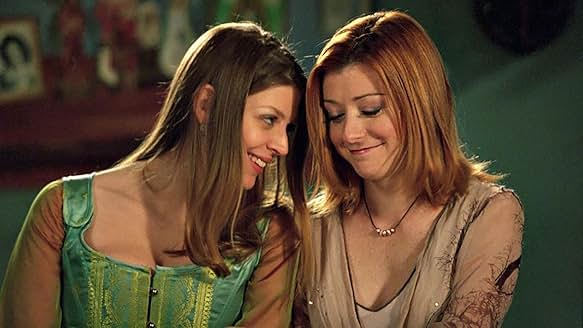
A frame from Buffy the Vampire Slayer of Tara (L) and Willow (R). Image from IMDB.
Alysia Yeoh – Batgirl
Issue 19 of The New 52 Batgirl allowed us to be a part of the intimate moment between Barbara and her best friend Alysia when Alysia finally states that she is a transgender woman. Alysia Yeoh is the first trans character in a Bat-comic, who also happens to be bisexual. The widespread support from fans made her a recurring character within the Batgirl graphic novel series and showed the world that not only should queer characters should be given more space in mainstream media, but when they are given that space they add substantial value to the lives of their fans. A tweet by Gail Simone said that a fan pointed out to her that in our praise of marginalized characters we must not forget to actively seek out and praise our marginalised creators, like DC comic writer Lilah Sturges who is so full of Pride for being her bold self.
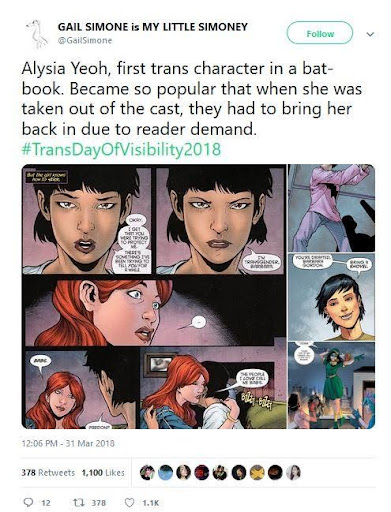
A screenshot of the tweet from Gail Simone speaking of the impact the character Alysia Yeoh had on the community and readers. Image from Gail Simona’s X account.
Kung Jin – Mortal Kombat
If you have the ability to rewrite a narrative to empower minorities, then it becomes your destiny to do so. Just one line of dialogue between Raiden (Richard Epcar) and Kung Jin (Johnny Yong Bosch) in a Mortal Kombat X cutscene, shows that certain spaces, when liberated, can amplify the effects of change. In a game that is generally known to be hyper-masculine with its gory fatalities and hyper-sexualised female fighters, Kung Jin being the first gay Mortal Kombat character could create a greater demand for more inclusive fighter games. Dominic Cianciolo confirmed on twitter that Kung Jin is gay and as expected many fans refused to accept the possibility of a non-heterosexual character existing within the Mortal Kombat universe despite direct confirmation from the writer. It is time that we grow as a community to be mature enough to understand that queer representation is not taking away space from the cis-hetero community but are only asking to stand beside them, united in our shared humanity. So if the Pride flag superimposed on the game logo is not clear enough to the haters, then Cianciolo’s tweet is evidence that it is time for fighter games to follow this incredible example because you can only fight change for so long.
They only care about what is in your heart, not whom your heart desires – Raiden to Kung Jin.
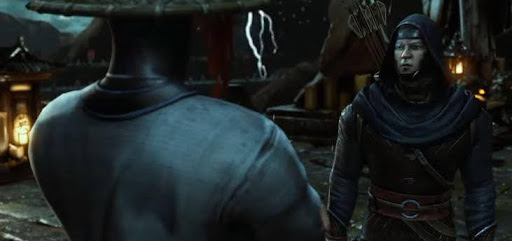
The cutscene where Raiden says the line, and confirms the first gay Mortal Kombat character. Image from Mortal Kombat X.
Todd Chavez– BoJack Horseman
No matter how hard you try to bring joy into the lives of others, these people will come and go eventually. Some of them will give you exactly what you need when they are still around and others may dull the rainbow in your heart, but nothing is guaranteed. What is a guarantee, however, is that the person you spend most of your time with and the person you go to bed with every night is yourself. Todd Chavez (Aaron Paul) teaches us that being who you really are is an act of self-love and freedom. It is hard though to be yourself when you know that just you existing is an act of rebellion against societal norms. In season four episode three of BoJack Horseman, “Hooray! Todd Episode”, Todd realises that he is asexual and the episode ends with him going to an asexual meet-up, finally doing something for himself.
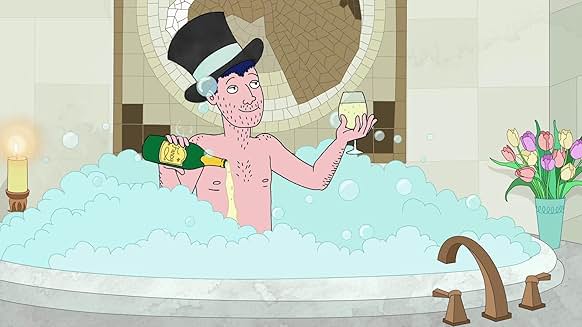
The asexual character, Todd Chavez, sits in a bath filled with bubbles, wearing a top hat pouring champagne into the bath. Image from IMDB.
Yuri Katsuki and Victor Nikiforov – Yuri!!! on Ice
I may not be a sucker for romance but Yuri Katsuki (Toshiyuki Toyonaga) and Victor Nikiforov (Jun’ichi Suwabe) really had me cutting up some seriously potent onions. It was heartwarming to see a homosexual romance without the homoerotic fetish. The anime placed its emphasis on the development of Yuri and Victor’s friendship that eventually led to their engagement in episode 10 of season one, “Gotta Supercharge It! Pre-Grand Prix Final Special!”. Majority of cartoon romances, anime romances, and romantic-comedy romances have been between a cis-hetero couple and this anime let the entire world know that queer relationships deserve the same adorable storylines that heterosexual couples have been given. What is even more worth noting is that this kind of representation is not only very rare in anime but Japan as a country has not yet fully legalised gay marriage.
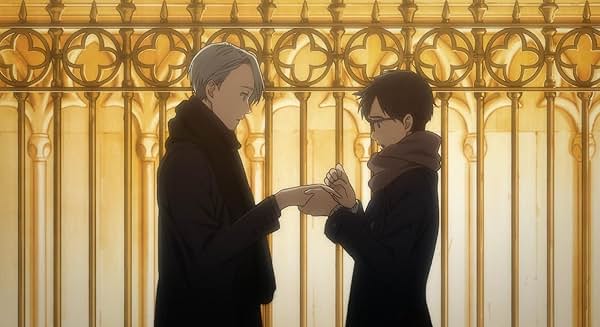
A frame from the Yuri!!! on ICE anime series of Yuri (R) and Victor (L). Image from IMDB.
When you give queer characters prominent voices in mainstream media, you are ultimately expanding your fan base. When your representations move into the margins, then the margins no longer exist. Hopefully, we will soon be putting queer characters into media not because we are fighting for their representational rights but because we have realised how natural their identities are in our society. We fight back the resistance in the present moment because one day in the future we will no longer have to fight as we take each stride toward equal human rights for all. It will happen. One page, one episode, one rally at a time.
© 2025 Cape Nerd Collective. All rights reserved.
Site designed by Dani Petersen and Luther de Lange